



Precision timekeeping is a foundational service in any distributed system. Whether synchronising Ethernet frames to a PTP grandmaster, timestamping die-to-die packet exchanges between chiplets, or scheduling time-critical hardware events, the system needs a clock that is accurate, capturable at multiple points simultaneously, and adjustable by both hardware servo loops and software without stopping.
All Projects
You can use the filters below to restrict this based on Technology or Skills.
For a chiplet system, you need a communication interface between chiplets. The industry has developed standards that require complicated IPs around UCIe and the CHI interface from Arm. For many academic projects these are probably more complicated than needed . The aim of this project is to produce a simple chiplet communications interface based around the open standard AXI protocol.
The project is hosted here: https://git.soton.ac.uk/soclabs/chiplets/axi-chiplet-controller
Reconfigurable Intelligent Surfaces (RIS) are planar structures composed of large arrays of tunable elements that can dynamically redirect, reflect, or shape wireless signals in the environment.
The PCK600 Arm IP provides components to allow a power control infrastructure to be distributed in a SoC in order to make a design energy efficient. Arm provide the IP as part of their Power Control System Architecture that can be used to control the power states of various parts of the system. This control of the power infrastructure is achieved through the use of the Power Policy Unit (PPU). This unit has an APB interface to allow for software control, and some low power interfaces that can connect to the power controllable IP within the system.
This project aims to develop an advanced RF energy harvesting (EH) receiver chip specifically designed to power embedded sensors for monitoring the condition of groceries during transportation. The receiver chip captures wireless energy transmitted from phased array antennas and converts it into electrical power that is used to operate onboard sensors, which continuously monitor critical parameters such as temperature and humidity inside delivery trucks.
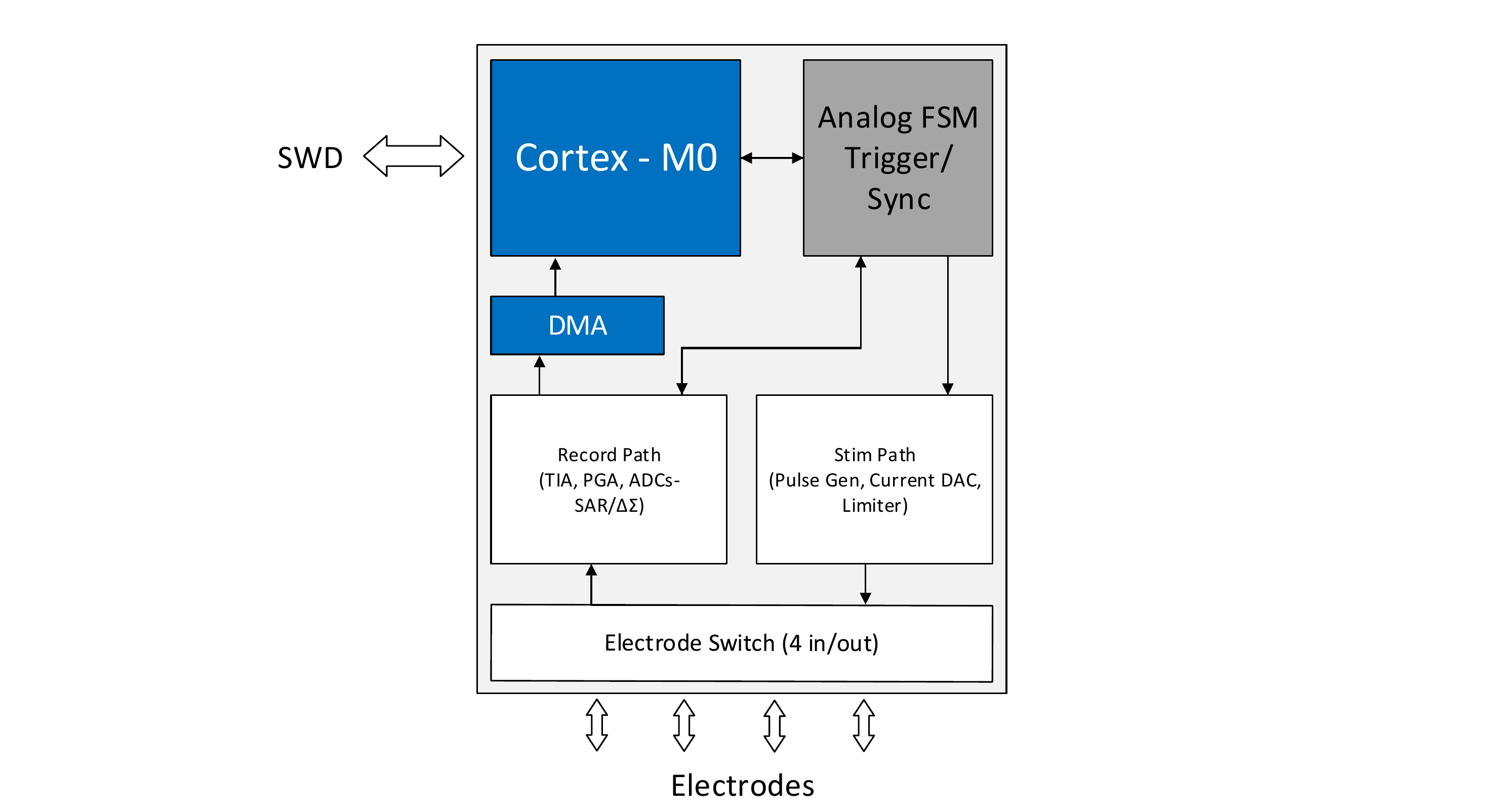
Stroke and epilepsy are among the most common debilitating neurological conditions, with a worldwide prevalence of 100 million people (World Stroke Organization, 2022) and 50 million people (World Health Organization, 2024), respectively. Present-day approaches for treating neurological and neurosurgical conditions include physiotherapy, pharmacological treatment, surgical excision, and interventions such as deep brain stimulation.
Daniel Newbrook
Fidel Makatia